Artículo original
Vol. 52 | Núm. 6 (diciembre 2025)
25 min
Beyond body weight: functional impairments in obese chilean children and the role of horizontal jump performance as a functional indicator
Más allá del peso corporal: limitaciones funcionales en escolares chilenos con obesidad y el rol del salto horizontal como indicador funcional
Carlos Poblete-Aro , Danáe Arancibia, Luis Peiret-Villacura, Fernando Concha Laborde, Paloma Ferrero-Hernández, Daniela González-Araya, Tito Pizarro Quevedo*
Universidad de Santiago de Chile, Facultad de Ciencias Médicas, Escuela de Ciencias de la Actividad Física, el Deporte y la Salud, Santiago, Chile
*Correspondencia:
*Tito Pizarro Quevedo. tito.pizarro@usach.cl
Recepción:
11/07/2025
Aceptación:
29/11/2025
Publicación:
31/12/2025
Métricas
360
Visualizaciones
39
Descargas
Compartir
Compartir
Resumen (ES)
Introducción: La alta prevalencia de sobrepeso y obesidad en escolares chilenos constituye un desafío importante para la salud pública, afectando su desempeño físico y bienestar integral. Objetivo: Analizar la relación entre el peso corporal y las capacidades físicas en escolares de 6 a 12 años de escuelas públicas de alta vulnerabilidad en Santiago, Chile. Métodos: Se realizó un estudio observacional transversal con 154 estudiantes de tres escuelas públicas, evaluando estado nutricional, condición física (fuerza de prensión manual, salto horizontal, test de agilidad 4x10 m) y capacidad motora. Las correlaciones se analizaron mediante el coeficiente de Spearman. Resultados: Se encontró una prevalencia de sobrepeso y obesidad de 42,8%. Los escolares con obesidad presentaron un desempeño significativamente menor en el salto horizontal en comparación con los eutróficos (p = 0,016). La fuerza de prensión mostró correlaciones moderadas con el peso y la talla, pero sin relevancia funcional. El salto horizontal demostró una correlación moderada con la fuerza de prensión y la agilidad, respaldando su valor como herramienta de tamizaje de la función motora. Conclusiones: El exceso de peso impacta negativamente la fuerza funcional en escolares, especialmente en tareas explosivas como el salto horizontal. Aunque no se observaron diferencias en la capacidad motora general entre categorías de IMC, la baja capacidad motora generalizada refuerza la necesidad de intervenciones escolares que fomenten el desarrollo de habilidades motoras y la actividad física. Programas basados en juegos y ejercicios de fuerza de alta intensidad en las escuelas representan una estrategia viable para mejorar la salud física y la calidad de vida de niños y niñas.
Palabras clave (ES):
Niñez
Condición física
Obesidad
Capacidad motora
Peso corporal
Salto horizontal
Resumen (EN)
Background: The high prevalence of overweight and obesity among Chilean schoolchildren represents a significant public health challenge, impacting their physical performance and overall well-being. Objective: To analyze the relationship between body weight and physical capacities in schoolchildren aged 6 to 12 years from highly vulnerable public schools in Santiago, Chile. Methods: A cross-sectional observational study was conducted with 154 students from three public schools, assessing nutritional status, physical fitness (handgrip strength, standing long jump, 4x10m shuttle run test), and motor capacity. Correlations were analyzed using Spearman’s coefficient. Results: A prevalence of overweight and obesity of 42.8% was found. Children with obesity had significantly lower performance in the standing long jump compared to normal weight peers (p = 0.016). Handgrip strength showed moderate correlations with weight and height but low functional relevance. The standing long jump test demonstrated a moderate correlation with handgrip strength and agility, supporting its value as a screening tool for motor function. Conclusions: Excess weight negatively impacts functional strength in schoolchildren, particularly in explosive tasks such as the standing long jump. Despite the absence of differences in overall motor capacity across BMI groups, the low general motor capacity observed highlights the need for school-based programs promoting motor skill development and physical activity. Play-based and high-intensity strength training activities in schools represent a feasible strategy to enhance children’s physical health and quality of life.
Palabras clave (EN):
Children
Obesity
Fitness
Motor capacity
Horizontal jump
Introduction
In Chile, issues related to nutritional health and physical fitness among school-aged children have gained increasing importance, particularly due to the observed rise in overweight and obesity rates1. Additionally, there has been a significant decline in physical activity levels among Chilean children, with 80% not meeting the minimum recommended levels of physical activity2.
The lack of regular physical activity and poor dietary habits are key factors that have led the Ministry of Health of Chile to establish clear goals in its National Health Strategy aimed at reducing obesity rates and improving the physical fitness of schoolchildren. The 2016-2017 National Health Survey of Chile (NHS) revealed that sedentary behavior affects 86.7% of the population, with adolescents being one of the most affected groups3. Additionally, the 2024 Nutritional Map from the National Board of School Assistance and Scholarships of Chile (JUNAEB) showed that 50.9% of students across all grade levels were overweight or obese. Childhood sedentary behavior and obesity represent a significant public health challenge4 with important short and medium-term consequences5. Physically, overweight and obese children may experience a range of health issues, including orthopedic, respiratory, and endocrine conditions, among others, which can impact their overall well-being from an early age. Moreover, the psychosocial consequences of childhood obesity, such as low self-esteem and negative body image, can influence personal development6. In the medium term, obesity during childhood and adolescence tends to persist into adulthood, increasing the risk of cardiovascular factors and the development of chronic diseases such as type 2 diabetes, hypertension, heart disease, stroke, and certain types of cancer7.
These data highlight the urgent need to implement interventions that address this problem from early childhood.
Physical activity interventions have a positive impact on the health-related quality of life of children and adolescents, enhancing aspects such as physical, psychological, and social well-being8. These interventions have also been associated with improvements in cardiovascular and overall physical health in children with overweight or obesity9. Long-term multicomponent exercise programs have also demonstrated reductions in BMI z-scores and improvements in metabolic indicators10. Resistance training has emerged as an especially effective modality for enhancing muscular strength and power in school-aged children. Reported benefits include gains in standing long jump performance, vertical jump height, and upper-body muscular endurance, such as push-up capacity11.
High-intensity interval training (HIIT) has been shown to significantly reduce anxiety while also improving physical fitness and academic performance among secondary school students, highlighting its potential as a school-based strategy12,13.
On the other hand, interventions based on games and resistance exercises have proven to be an effective method for improving the physical, psychological, and social health and well-being of children and adolescents when they are well-structured and supervised by qualified professionals14. These programs not only increase muscular strength and power, but also contribute to reducing cardiovascular risk, strengthening bones, improving body composition, and enhancing motor skills, in addition to having a positive impact on the psychosocial health of youth14. Likewise, the incorporation of playful activities in school settings has shown positive effects on adherence to physical activity, as it increases motivation and enjoyment among participants15,16. These benefits underscore the importance of developing school-based programs that promote strength through play and recreation. In this sense, brief and high-intensity interventions delivered in a friendly and engaging format that uses play as the main strategy may be an effective alternative for this population, given that play is a natural and inherent activity during childhood.
Between 2018 and 2022, the Universidad de Santiago de Chile (USACH), in collaboration with the Universidad del Desarrollo de Chile (UDD), implemented the ANID FONDEF 18I100016 project titled “Development, Scaling, and Validation of an Integrated System of Interventions in Schoolchildren on Nutrition, Physical Activity, and the Community Environment in Ciudad Sur.” The project was based on the hypothesis that “modifications to school and community environments can improve dietary and physical activity habits to reduce overweight and obesity among schoolchildren in Ciudad Sur through structural, individual, participatory, and information and communication technology strategies.”
Due to the social uprising (2019) and the COVID-19 pandemic (2020–2021), the project’s main outcomes included the creation of school parliaments, social marketing initiatives, a georeferencing system for the school environments to identify areas for improvement, the installation of water fountains and sports equipment in each school, a proposed model for integrating nutrition and physical activity planning into various school subjects, and the development and implementation of a manual for resistance exercises and high-intensity games for the health of children FONDEF IT18I0016.
From this perspective, the creation and application of a manual of games and resistance exercises emerges as a practical and accessible solution to promote healthy habits in the school population. This manual aims to foster comprehensive and sustainable development, highlighting the importance of play-based motor activities as a fundamental tool for the health and well-being of children17.
Building on this approach, we developed the project titled “Intervention in Early Primary Schoolchildren in Public Schools Based on Games and Resistance and High-Intensity Exercises,” which is presented as a direct response to the identified needs. The intervention is justified not only by the high prevalence of overweight and obesity detected, but also by the scientific evidence supporting the benefits of regular and structured physical activity for the overall health of children.
This paper presents the results of the diagnostic evaluations conducted in a 2023 study to apply the manual developed within the FONDEF IT18I0016 “Intervention in Early Primary Schoolchildren in Public Schools Based on Games and Resistance and High-Intensity Exercises,” which was carried out in three educational institutions belonging to the Gabriela Mistral Local Public Education Service.
Therefore, the objective of this study was to analyze the relationship between body weight and physical capacities in schoolchildren aged 6 to 12 years from highly vulnerable public schools in Santiago, Chile, as part of the baseline evaluation of a project that continues the work initiated by FONDEF IT18I0016.
Materials and methods
Design and participants
A cross-sectional, observational, and correlational study was conducted in 2023 as part of a project that continues the work initiated by FONDEF IT18I0016. The sample included schoolchildren from three public schools in the southern area of Santiago, selected through a non-probabilistic convenience sampling strategy. Although this sampling technique was used, all students enrolled in grades 1 through 4 (n = 420) were invited to participate. A total of 154 students (36.7% response rate) completed the instrument voluntarily and were included in the final analysis. No exclusion criteria were applied beyond voluntary non-participation.
Inclusion criteria were: i) enrolment in the selected schools, ii) attending early primary school, and iii) being between 6 and 10 years old. Exclusion criteria included: i) any student with a medical condition prescribed and certified by a physician, or ii) any student unable to participate in physical exercise or follow instructions due to cognitive limitations that would pose a risk to their physical health. Participation was confirmed through written informed consent from each legal guardian, who signed the document to authorize their child’s participation, as well as informed assent from the children themselves. Following the application of inclusion and exclusion criteria and considering only those students who provided signed parental informed consent and child assent, the final analysis was conducted on a sample of 154 students. The study was approved by the Ethics Committee of the Universidad de Santiago de Chile (N°388/2023) and followed the guidelines of the Declaration of Helsinki.
The participating schools belong to three low-income urban municipalities in the Metropolitan Region (Macul, San Joaquín, and La Granja). In Chile, school vulnerability is measured by an index associated with poverty, ranging from 0 to 100. The average vulnerability index of the participating schools was 76%, placing them in the high vulnerability range18.
Procedures
Physical fitness and motor capacity were evaluated at both the beginning and end of the intervention. Nutritional status was assessed using the Body Mass Index-for-age, measured with a SECA 813 digital scale and SECA 217 stadiometer (Nutritional Assessment MINSAL, 2017). Handgrip strength was measured with a BASELINE® LITE® Hydraulic Dynamometer/90 kg, considering the best of two attempts19. Lower-body explosive strength was assessed using the standing long jump test, recording the best of two attempts20. Agility was evaluated with the 4×10m shuttle run test, adapted by Ruiz et al.21, recording the best time in seconds and hundredths of a second Ruiz et al.21. Finally, motor capacity was evaluated through five movements (overhead squat, hip hinge, medicine ball throw, corebag drag, and contralateral superman), observed and scored by the evaluator according to task execution (1–4 points) for each of the five exercises. Motor control was then categorized as low (5 to 10 points), moderate (11 to 15 points), or high (16 to 20 points)17. The evaluation team underwent a standardization and training process prior to conducting all measurements.
Statistical analysis
Data was analyzed using JAMOVI software (version 2.4). Continuous variables were described using mean and standard deviation. The normality of the variables was assessed using the Shapiro-Wilk test, and the homogeneity of variances was evaluated using Levene’s test.Since most variables did not exhibit a normal distribution (p < 0.05), Welch’s ANOVA was used for comparisons among nutritional status groups, along with the Games-Howell post hoc test. For variables that did meet the normality and homogeneity of variance assumptions (p ≥ 0.05), a one-way ANOVA with Tukey’s post hoc test was applied.Regarding correlations, Spearman’s coefficient was used to evaluate the associations between anthropometric, physical fitness, and motor capacity variables, given that the normality assumption was not met in most cases. A p-value < 0.05 was considered statistically significant for all tests. In this study, the strength of the correlations was interpreted according to the thresholds proposed by Hinkle et al.22, where ρ values below 0.30 were considered negligible or insignificant in terms of clinical relevance, despite possible statistical significance. Correlations between 0.30 and 0.49 were classified as low, reflecting a meaningful but weak relationship. Moderate correlations ranged from 0.50 to 0.69, high correlations from 0.70 to 0.89, and very high correlations from 0.90 to 1.00. These thresholds allow for a more nuanced interpretation of the magnitude of the associations observed between anthropometric, fitness, and motor skill variables in this population.
Results
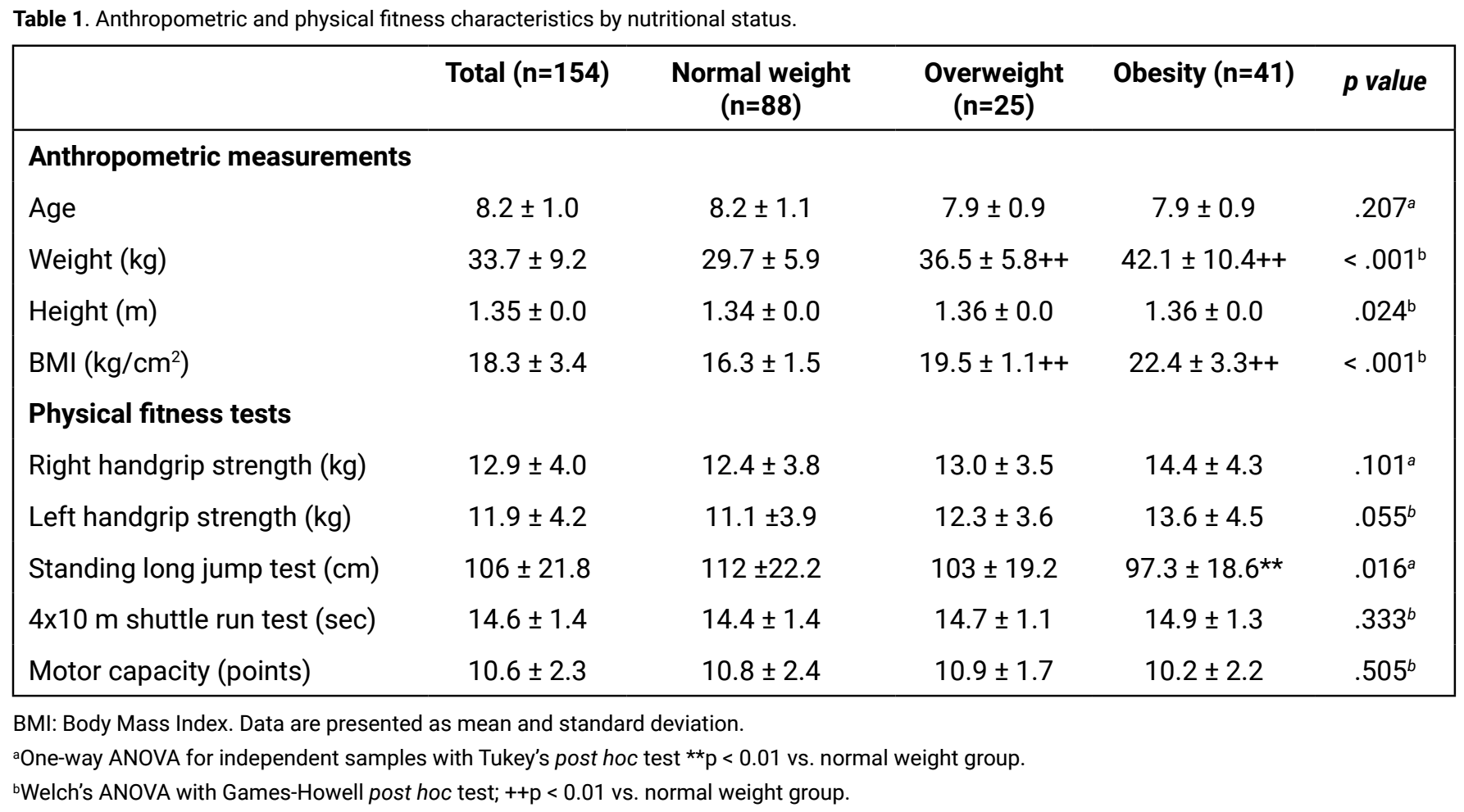
Out of the 420 schoolchildren invited to participate, a total of 154 students completed the instrument and were included in the final sample. Participants were categorized according to their BMI-based nutritional status: 57.1% were classified as having normal weight, 16.2% as overweight, and 26.6% as having obesity. The mean age of the sample was 8.2 years. Table 1 presents the anthropometric and physical fitness characteristics of the participants according to nutritional status. The obesity group exhibited the highest means for weight, height, and BMI compared to the other two categories. In addition, this group showed the highest results for right and left handgrip strength, with means of 14.4 ± 4.3 kg. and 13.6 ± 4.5 kg. respectively. Moreover, the obesity group recorded the lowest means for the standing long jump test (97.3 ± 18.6 cm) and motor capacity (10.2 ± 2.2 points), with a significantly shorter jump distance compared to the normal weight group (Table 1).
Tables 2, 3, and 4 present the correlations between anthropometric measurements, motor capacity, and standing long jump performance with physical fitness tests, respectively.
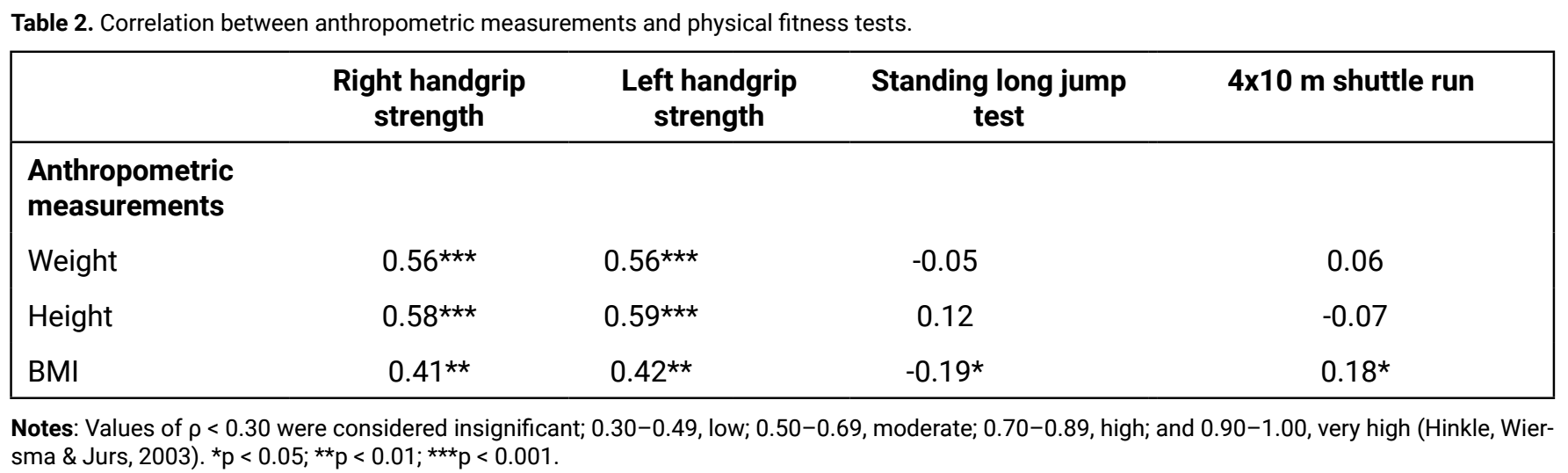


Right-hand grip strength showed a high Spearman correlation with weight (ρ = 0.56; p < 0.001) and height (ρ = 0.59; p< 0.001), as well as a low correlation with BMI (ρ = 0.42; p < 0.01). It also showed a low association with the standing long jump (ρ = 0.33, p < 0.001) and an insignificant association with motor capacity (ρ = 0.25, p < 0.01).
Left handgrip strength similarly showed a high correlation with weight (ρ = 0.56; 0.01). It also had a low correlation with the standing long jump (ρ = 0.34; p < 0.001) and an insignificant correlation with motor capacity (ρ = 0.27; p < 0.01).
Motor capacity showed a low inverse correlation with the 4×10m shuttle run test (ρ = -0.37; p < 0.001), suggesting that greater motor capacity is associated with faster execution time in the agility test.
The standing long jump showed a low correlation with right (ρ = 0.33, p < 0.001) and left (ρ = 0.34, p < 0.001) handgrip strength, and a high negative correlation with the 4x10m shuttle run test (ρ = -0.50, p < 0.001), reflecting that better jump performance is associated with greater handgrip strength and shorter agility test execution time.
Although statistically significant but negligible correlations were observed between BMI and the 4×10m shuttle run test (ρ = 0.18; p ≤ 0.05) and the standing long jump (ρ = -0.19; p ≤ 0.05), the magnitude of these associations was insignificant, indicating a limited clinical relevance of BMI on functional performance in these tests.
In the sample, when comparing by sex (boys n=82 and girls n=72), no significant differences were observed in any of the variables considered for analysis.
Discussion
In this study, 154 schoolchildren were evaluated based on their nutritional status and physical performance, revealing an overweight and obesity prevalence of 42.8% (overweight 16.2% and obesity 26.6%). Children with obesity showed lower performance in the standing long jump test compared to their normal-weight peers. Moderate correlations were observed between weight/height and handgrip strength, and negative correlations between BMI and standing long jump test, although with low clinical relevance (ρ < 0.30). Additionally, motor capacity was positively associated with handgrip strength and agility (ρ < 0.30), without significant differences between nutritional status groups (normal weight, overweight, and obese). Finally, a significant correlation was found between height and motor capacity, also with low clinical relevance (ρ < 0.30).
In this study, obese schoolchildren had significantly lower performance in the standing long jump test compared to their normal-weight peers (97.3 ± 18.6 cm vs. 112 ± 22.2 cm, p = 0.016). Moreover, higher BMI levels were negatively correlated with jump performance (ρ= -0.19), consistent with previous literature reporting a reduction in relative muscular power among overweight pediatric populations23. This finding suggests that excess body mass, far from providing functional benefits, may negatively impact on tasks that require explosive strength and motor coordination. Unlike handgrip strength, which can be mechanically influenced by body weight without necessarily reflecting better functional status, the standing long jump represents a complex motor skill that depends on the force-power-weight relationship. This reinforces the diagnostic value of the standing long jump as a screening tool for detecting functional limitations associated with overweight in school settings, as proposed by Guillamón et al.24 and Fernández-Galván et al.25. Moreover, its sensitivity in discriminating the impact of obesity on physical performance makes it a key test for evaluating school-based interventions aimed at improving motor health in highly vulnerable contexts.
Moreover, the evaluated motor capacity had a mean score of 10.6 ± 2.3 points for all children assessed, placing it in the low (5 to 10 points) to moderate (11 to 15 points) motor control category, with no significant differences observed across BMI categories (normal weight, overweight, obese). In contrast, previous studies have demonstrated that children with normal weight have significantly better motor development than those with overweight or obesity26, along with higher levels of proprioception27. Nevertheless, despite the lack of significant differences between BMI categories and motor capacity, a positive correlation was observed between motor capacity and other physical fitness tests, including handgrip strength, standing long jump test, and the 4x10m shuttle run test. Other studies have shown similar results, indicating a correlation between higher aerobic capacity and better performance in the standing long jump test, as well as an overall better motor/muscular capacity with a higher VO2max, and an association with motor coordination in schoolchildren aged 8 to 12 years24. Likewise, schoolchildren with greater strength levels have also demonstrated superior motor capacity, speed-agility, and aerobic capacity28, consistent with our findings. These results underscore the importance of incorporating motor skill development into the planning of Physical Education and Health classes to support comprehensive physical fitness in children at this developmental stage, regardless of nutritional status.
One key finding from the results presented is the positive correlation between the standing long jump test and handgrip strength in both hands, as well as faster execution times in the 4×10m shuttle run test.
The highest handgrip strength values were observed in students with higher body mass, which may be influenced by weight rather than reflecting superior functional performance. Although handgrip strength has been widely used in adults as a general indicator of muscular strength29 its utility in schoolchildren should be interpreted with caution. In this study, the standing long jump test emerged as a more sensitive test for detecting differences in relative functional strength, aligning with previous studies linking the standing long jump to sprint speed, sprint acceleration, and the triple jump in adults30, and sprint speed in children and adolescents31.
In primary school children, motor coordination was found to significantly influence strength and agility, reinforcing the importance of the standing long jump as an indicator of motor development at this stage32, since proper performance in the standing long jump involves lower-body strength combined with upper-body swinging coordination25. In preschool-aged children, jumping skills have been shown to be strongly associated with balance and lower limb strength, highlighting their role in the maturation of motor control and the progression toward more complex movements33.
Our study observed a correlation between the standing long jump test and the execution time in the 4×10m shuttle run test. In the sports context, a review of soccer players demonstrated that standing long jump test performance has a significant correlation with sprint speed, suggesting its utility for evaluating power and movement efficiency in sports25.
Additionally, biomechanical studies have indicated that standing long jump test performance is determined by factors such as explosive strength and intermuscular coordination, establishing it as a valid test for assessing motor performance in various contexts34,35, including the school environment.
The 2018 Chilean Physical Activity Report Card revealed that, despite progress in environmental and policy-related areas (rated B and B−, respectively), physical activity behaviors among children and adolescents remain worryingly low: overall physical activity (D−), participation in organized sports (D−), active transportation (F), sedentary behavior (C−), fitness (D), and prevalence of overweight and obesity (D−). Furthermore, the lack of data prevented the evaluation of key indicators such as active play, sleep, and inclusion. These findings underscore the need for more effective multisectoral strategies to increase physical activity and reduce sedentary behavior among Chilean schoolchildren2.
This study presents certain methodological limitations that must be considered when interpreting the results obtained. First, participant selection was conducted using non-probabilistic convenience sampling. While this sampling method allowed access to a representative sample of schoolchildren within the context and time constraints of the study, the lack of randomization introduces a potential selection bias that could affect the external validity of the study and the generalizability of the findings to other populations and educational contexts. The final sample consisted of 154 participants out of the 420 students invited, representing a response rate of only 36.7%. This low participation rate may limit the generalizability of the results and introduce self-selection bias. This is particularly relevant given that individuals with overweight or obesity are often more reluctant to participate in studies assessing physical fitness and nutritional status. Consequently, the results may not fully capture the variability or prevalence of nutritional issues within the broader school population36, 37.
Additionally, the distribution across the three nutritional status categories was unequal. This imbalance may have introduced a potential type II error, limiting the study’s ability to detect significant differences among the analyzed variables and categories. Consequently, the smaller number of overweight and obese subjects may have influenced the magnitude of the associations observed, suggesting the need to consider more balanced samples between nutritional status categories in future studies36,37.
Finally, another potential limitation relates to the study design itself. As this study presents a baseline in a cross-sectional format, the data collected reflects a single measurement point, preventing the establishment of causal relationships between the studied variables. Although associations between different indicators were identified, it is not possible to determine whether these relationships are causal or influenced by other uncontrolled external factors.
The results of this study indicate that schoolchildren with obesity exhibit significantly lower performance in key functional tests, such as the standing long jump test, which showed significant correlations with agility and motor capacity tests. This combination of reduced relative strength and limited motor control proposes a pattern of physical performance decline that may compromise active participation in play, autonomous movement, and daily physical activity. At early ages, these limitations are not only indicators of reduced physical fitness but also represent a risk factor for motor and social exclusion, directly affecting the quality of life and overall well-being of children. The negative relationship between excess body weight and functional strength, as evidenced in the standing long jump test, underscores the need to address childhood obesity not only from a nutritional perspective but also through systematic promotion of motor development in the school setting as part of a comprehensive health strategy.
Despite the stated limitations, the findings of this study provide relevant information on the relationship between nutritional status and physical fitness, as measured by strength and agility tests in schoolchildren. These results add to the existing scientific evidence, reinforcing the importance of implementing intervention strategies based on strength-based and high-intensity games that respond to the specific needs of children and adolescents. Future studies should consider incorporating dietary patterns to provide a more comprehensive understanding of the factors associated with physical fitness and nutritional status in school-aged populations.
Conclusions
This study demonstrated that schoolchildren with obesity show inferior performance in standing long jump test, reflecting a negative impact of excess weight on physical performance. Additionally, a direct relationship was observed between higher body mass and greater handgrip strength, although this did not translate into better functional performance, underscoring the importance of evaluating functional rather than absolute strength. The generally low motor capacity observed across the sample, regardless of nutritional status, highlights the urgent need for systematic school-based interventions that promote the development of motor skills, strength, and agility from early ages. Implementing programs based on strength games and high-intensity physical activity within the school context represents an accessible, sustainable, and potentially transformative strategy to improve the physical health and quality of life of children, especially in communities facing social vulnerability.
Acknowledgement
We would like to thank the National Agency for Research and Development (ANID) for funding the execution of the FONDEF IT18I0016 project. Likewise, we extend our appreciation to the Gabriela Mistral Local Public Education Service (SLEP) for their collaboration in developing initiatives aimed at promoting school health. Finally, special thanks go to the educational communities of the three participating schools in this study, whose willingness, commitment, and participation were essential to the success of this work.
Funding
This research did not receive any specific grant from funding agencies in the public, commercial, or not-for-profit sectors.
Authors’ contribution
The authors certify that they contributed equally to the conception, design, scientific and intellectual content, and writing of the manuscript.
Conflict of interest
The authors declare that they have no conflict of interest.
Artificial intelligence usage disclaimer
It is hereby disclosed that the AI tool ChatGPT (OpenAI) was used solely for technical translation and grammatical revision of the text in this document. The tool was not involved in the generation of original academic content, data analysis, or the formulation of conclusions. Full responsibility for the accuracy, fidelity, and scientific validity of the content lies with the author.
References
- Cigarroa I, Sarqui C, Palma D, Figueroa N, Castillo M, Zapata-Lamana R, et al. Estado nutricional, condición física, rendimiento escolar, nivel de ansiedad y hábitos de salud en estudiantes de primaria de la provincia del bio bío (Chile): estudio transversal. Revista Chilena de Nutricion. 2017;44(3):209–17.
- Aguilar-Farias N, Miranda-Marquez S, Martino-Fuentealba P, Sadarangani KP, Chandia-Poblete D, Mella-Garcia C, et al. 2018 chilean physical activity report card for children and adolescents: Full report and international comparisons. J Phys Act Health. 2020;17(8):807–15.
- Ministerio de Salud (MINSAL). ENCUESTA NACIONAL DE SALUD 2016-2017 Primeros resultados. 2017.
- Prentice-Dunn H, Prentice-Dunn S. Physical activity, sedentary behavior, and childhood obesity: A review of cross-sectional studies. Vol. 17, Psychology, Health and Medicine. Routledge; 2012. p. 255–73.
- Ximena Raimann DT, Francisco Verdugo DM. Actividad Física en la prevención y tratamiento de la obesidad infantil. Rev Med ClinCondes. 2011;23(3):218–25.
- Daniels SR. The consequences of childhood overweight and obesity. Vol. 16, Future of Children. 2006. p. 47–67.
- Reilly JJ, Kelly J. Long-term impact of overweight and obesity in childhood and adolescence on morbidity and premature mortality in adulthood: Systematic review. Vol. 35, International Journal of Obesity. 2011. p. 891–8.
- Bermejo-Cantarero A, Sánchez-López M, Álvarez-Bueno C, Redondo-Tébar A, García-Hermoso A, Martínez-Vizcaino V. Are Physical Activity Interventions Effective in Improving Health-Related Quality of Life in Children and Adolescents? A Systematic Review and Meta-Analysis. Sports Health. SAGE Publications Inc.; 2023.
- Migueles JH, Cadenas-Sanchez C, Lubans DR, Henriksson P, Torres-Lopez L V., Rodriguez-Ayllon M, et al. Effects of an Exercise Program on Cardiometabolic and Mental Health in Children with Overweight or Obesity: A Secondary Analysis of a Randomized Clinical Trial. JAMA Netw Open. 2023 Jul 27;6(7):E2324839.
- García-Hermoso A, Escalante Y, Domínguez AM, Saavedra JM. Effects of an exercise program during three years in obese boys: an intervention study. Retos [Internet]. 2013;23(23):10–3. Available from: www.retos.org
- Wu J, Yang Y, Yu H, Li L, Chen Y, Sun Y. Comparative effectiveness of school-based exercise interventions on physical fitness in children and adolescents: a systematic review and network meta-analysis. Vol. 11, Frontiers in Public Health. Frontiers Media S.A.; 2023.
- Pastén Hernández P, De Souza Lima J. Effects of an 8-week high-intensity exercise program on anxiety and academic performance in high school students. Sport TK- Euro American Journal of Sport Sciences. 2024;13.
- Javiera Abarzúa V, Williams Viloff C, Javiera Bahamondes V, Yeritza Olivera P, Poblete-Aro C, Herrera-Valenzuela T, et al. Efectividad de ejercicio físico intervalado de alta intensidad en las mejoras del fitness cardiovascular, muscular y composición corporal en adolescentes: Una Revisión. Rev Med Chil. 2019 Feb 1;147(2):221–30.
- Félix Saavedra JF. Prescripción de ejercicios de fuerza para niños y adolescentes. Revista Mexicana de Ciencias de la Cultura Física [Internet]. 2022 Jan 27;1(1):1–23. Available from: https://revistascientificas.uach.mx/index.php/rmccf/article/view/914
- Farias Valenzuela C, Cofre C, Ignacio S, Lazo E, Valdivia-Moral P. El juego motriz estructurado como estrategia de adherencia y estimulación cardiometabólica en ambientes escolares. In: Hinojo-Lucena F, Trujillo-Torres, Sola-Reche J, Alonso-García S, editors. Innovación Docente e Investigación Educativa en la Sociedad del Conocimiento [Internet]. Madrid, España: Editorial Dykinson; 2020. p. 281–96. Available from: https://www.researchgate.net/publication/340541216
- Ortiz-Zorrilla F, Taveras-Espinal J, Bennasar-García M. Juegos recreativos en el fomento de las capacidades físicas durante la clase de educación física. Revista Innova Educación. 2023 Jul 4;5(3):52–70.
- Cofré Bolados C, Suárez Reyes M, Pizarro Quevedo T, Jofré Saldía E, editors. Manual de fuerza y juegos de alta intensidad para la salud en niños, niñas y jóvenes. Primera edición. Santiago: Universidad de Santiago de Chile; 2022.
- JUNAEB. JUNAEB. 2024.
- Garcia-Hermoso A, Cofre-Bolados C, Andrade-Schnettler R, Ceballos-Ceballos R, Fernandez-Vergara O, Vegas-Heredia ED, et al. Normative reference values for handgrip strength in chilean children at 8-12 years old using the empirical distribution and the lambda, mu, and sigma statistical methods. Journal of Strength and Conditioning Research [Internet]. 2021;35(1):260–6. Available from: www.nsca.com
- Castro-Piñero J, Ortega FB, Artero EG, Girela-Rejón MJ, Mora J, Sjöström M, et al. Assessing muscular strength in youth: Usefulness of standing long jump as a general index of muscular fitness. Journal of Strength and Conditioning Research [Internet]. 2010;24(7):1810–7. Available from: www.nsca-jscr.org
- Ruiz JR, Castro-Piñero J, España-Romero V, Artero EG, Ortega FB, Cuenca MAM, et al. Field-based fitness assessment in young people: The ALPHA health-related fitness test battery for children and adolescents. Br J Sports Med. 2011 May;45(6):518–24.
- Hinkle DE, Wiersman W, Jurs SG. Applied statistics for the behavioral sciences. 5th Edition. London: Houghton Mifflin; 2003.
- Sepúlveda Cáceres X, Méndez Cornejo J, Duarte Farfán C, Herrera M, Gómez-Campos Ro, Lazari E, et al. Relationship between body adiposity and horizontal jump in school children and adolescents. Rev Chil Pediatr. 2018;89(6):701–8.
- Guillamón AR, García-Cantó E, Pérez Soto JJ, Rodríguez García PL. Capacidad aeróbica y su relación con parámetros de la condición física saludable en escolares. Revista Facultad de Ciencias de la Salud UDES. 2015 Dec 30;2(2):90.
- Fernández-Galván LM, Casado A, Domínguez R. Evaluación y prescripción del salto vertical y horizontal en futbolistas. Revisión narrativa. Retos. 2024; 52:410–20.
- Bucco-Dos Santos L, Zubiaur-Gonzalez M. Desarrollo de habilidades motoras fundamentales en función del sexo y del índice de masa corporal. Cuadernos de Psicología del Deporte. 2013;13(2):63–72.
- Guzmán-Muñoz E, Concha-Cisternas Y, Méndez-Rebolledo G, Vásquez-Muñoz M, Valdés-Badilla P, Herrera-Valenzuela T, et al. Relationship Between Body Mass Index and Fat Mass Percentage with Proprioception in Children. J Funct Morphol Kinesiol. 2025 Mar 1;10(1).
- Rosa-Guillamón A, García-Cantó E. Relación entre fuerza muscular y otros parámetros de la condición física en escolares de primaria. SPORT T: Revista EuroAmericana de Ciencias del Deporte. 2017; 6:107–16.
- Vieira FT, Cai Y, Gonzalez MC, Goodpaster BH, Prado CM, Haqq AM. Poor muscle quality: A hidden and detrimental health condition in obesity. Rev Endocr Metab Disord. 2025.
- Lin J, Shen J, Zhang J, Zhou A, Guo W. Correlations between horizontal jump and sprint acceleration and maximal speed performance: a systematic review and meta-analysis. PeerJ. 2023 Feb 1;11.
- Mello JB, dos Santos Pinheiro E, Ferreira GD, Bergmann GG, Fernandes RA. Relationship between Sprint, lower limb power, and change of direction speed in adolescents. Motriz Revista de Educacao Fisica. 2021 Mar 1;27.
- Vázquez Ramos FJ, Cenizo Benjumea JM, Ramírez Hurtado JM, Gálvez González J. Relación de la coordinación motriz, edad y sexo con la fuerza y agilidad en escolares. Sportis Scientific Journal of School Sport, Physical Education and Psychomotricity. 2022 Sep 1;8(3):458–77.
- Gieysztor E, Dawidziak A, Kowal M, Paprocka-Borowicz M. Jumping Motor Skills in Typically Developing Preschool Children Assessed Using a Battery of Tests. Sensors. 2024 Feb 1;24(4).
- Dobbs CW, Gill ND, Smart DJ, Mcguigan MR. Relationship between vertical and horizontal jump variables and muscular performance in athletes. Journal of Strength and Conditioning Research [Internet]. 2015;29(3):661–71. Available from: www.nsca.com
- García-López J, Peleteiro J. Test de salto vertical (II): Aspectos Biomecánicos. Revista Digital: Rendimiento Deportivo [Internet]. 2008; Available from: http://www.rendimientodeportivo.com/N007/artic032.htm
- Brehm E, Tschuschke L, Klos L, Burchartz A, Volk C, Hanssen-Doose A, et al. Physical activity and weight status of children in Germany: cross-sectional results from the MoMo Wave 3 (2018–2020). Eur J Pediatr. 2025 Jun 1;184(6).
- Uvacsek M, Wágner B, Simkó G. Sport and Physical Activity Participation by Weight Groups in School-Aged Hungarian Children. Applied Sciences (Switzerland). 2024 Aug 1;14(15).
Explorar
Artículos
Volúmenes
Sobre la revista