Artículo original
Vol. 51 | Núm. 1 (Febrero 2024)
24 min
Efecto del refinado y de la temperatura de prensado en los atributos químicos del aceite de colza producido en Chile
Effect of refining and pressing temperature on chemical attributes of canola oil produced in Chile
Miguel Ángel Rincón-Cervera¹,², Nalda Romero³, Paula Jimenez⁴, Sergio Palma DF⁴, Camila Farias⁴,
Camila Cisternas⁴, Catalina Guzmán⁴, Libny Hevia⁴, Rodrigo Valenzuela⁴.
1. Department of Agronomy, Food Technology Division, University of Almería, Spain.
2. Institute of Nutrition and Food Technology, University of Chile, Santiago, Chile.
3. Department of Food Science and Chemical Technology, Faculty of Chemical Sciences and Pharmacy, University of Chile, Santiago, Chile.
4. Nutrition Department, Faculty of Medicine, University of Chile, Santiago 8380000, Chile.
https://doi.org/10.4067/s0717-75182024000100007
Recepción:
16/08/2023
Aceptación:
03/12/2023
Publicación:
28/02/2024
Métricas
67
Visualizaciones
20
Descargas
Compartir
Compartir
Resumen (ES)
El consumo de aceites vegetales es habitual en nuestra dieta diaria. El aceite de colza (aceite de canola) es el tercer aceite comestible más consumido en el mundo, seguido por los aceites de palma y soja en términos de producción. El aceite de colza tiene una baja proporción de ácidos grasos saturados, mientras que es rico en ácidos grasos insaturados, así como en compuestos liposolubles saludables como fenoles, tocoferoles, fitoesteroles, carotenoides y vitaminas. Sin embargo, las tecnologías de procesamiento afectan el contenido y las actividades funcionales de los compuestos bioactivos en el aceite. Objetivo: Evaluar cualquier efecto potencial del prensado en caliente o en frío y un proceso de refinación sobre el valor nutricional y el perfil de varios compuestos bioactivos en los aceites de canola producidos en Chile. Métodos: Los aceites de canola se caracterizaron en cuanto a su perfil de ácidos grasos, composición de fitoesteroles y tocoferoles, contenido de fenoles totales y actividad antioxidante, según el modo de extracción (prensado en frío o en caliente) y antes y después de ser sometidos a un proceso de refinación. Resultados: Los perfiles de ácidos grasos no fueron significativamente diferentes en ninguno de los aceites de canola analizados. La refinación, pero no la extracción en caliente, condujo a una fuerte disminución de los fitoesteroles y tocoferoles. El prensado en caliente aumentó significativamente la cantidad de fenoles totales (3,1 veces) y la actividad antioxidante medida por ORAC (3,1 veces) y DPPH (8,3 veces) en comparación con la extracción en frío. Sin embargo, la concentración de fenoles y la capacidad antioxidante disminuyeron después del refinado. Conclusión: Los procesos de refinación deben ajustarse para reducir la pérdida de compuestos bioactivos en el aceite.
Palabras clave (ES):
Aceite de canola
Refinación de petróleo
Ácidos grasos
Compuestos bioactivos
Actividad antioxidante
Resumen (EN)
Rapeseed oil (canola oil) is the third most consumed edible oil in the world, followed by palm and soybean oils in terms of production. Rapeseed oil has a low proportion of saturated fatty acids, while it is rich in unsaturated fatty acids, as well as in healthy compounds such as phenols, tocopherols, phytosterols, carotenoids, and fat-soluble vitamins. However, processing technologies affect the content and functional activities of bioactive compounds in the oil. Aim: To assess any potential effect of hot or cold pressing and a refining process on the nutritional value and the profile of several bioactive compounds in canola oils produced in Chile. Methods: Canola oils were characterized regarding their fatty acid profile, phytosterol and tocopherol composition, total phenol content, and antioxidant activity, according to the mode of extraction (cold or hot pressed) and before and after bWeing subjected to a refining process. Results: Fatty acid profiles were not significantly different in any of the analyzed canola oils. Refining but not temperature extraction led to a sharp decrease of phytosterols and tocopherols. Hot pressing significantly increased the amount of total phenols (3.1 times) and the antioxidant activity measured by ORAC (3.1 times) and DPPH (8.3 times) compared to the cold extraction. However, phenolic concentration and antioxidant capacity decreased after refining. Conclusions: Refining processes should be adjusted to reduce the loss of bioactive compounds in the oil.
Palabras clave (EN):
Antioxidant activity
Canola oil
Oil refining
Fatty Acids
Bioactive compounds
Introduction
Rapeseed (Brassica napus) is a plant belonging to the Brassicaceae family whose seed oil contains typically high amounts of erucic acid (EA, C22:1n-9) (>40% of total fatty acids)1,2. Toxic effects have been described for EA in animal studies, leading to myocardial lipidosis (accumulation of triacylglycerols in the myocardial tissue), and high levels of EA in human plasma phospholipids have been associated with increased risk of congestive heart failure3. Due to safety concerns of EA, industrial rapeseed oil is produced for non-food uses. However, a low-erucic acid rapeseed oil was obtained in 1976 through plant breeding in Canada which led to a commercially consumable oil called “canola oil” (coming from Canadian Oil Low-Acid)2,4. Canola oil is characterized by a content of EA lower than 2% of total fatty acids for human and animal consumption2. Canada produced more than 4.5 MT of canola oil in 2019/2020 and exported more than 3.3 million of MT of canola oil in 2020, mainly to the United States, China, South Korea, Chile, and Mexico5.
Canola oil is nutritionally relevant because of its richness in monounsaturated fatty acids (MUFA) (63-65% of total fatty acids), mainly oleic acid (OA, C18:1n-9) (≈ 60%); value close to that found in extra virgin olive oil (55-83%). Canola oil is also low in saturated fatty acids (SFA) (5-7% of total fatty acids), being palmitic acid (C16:0) the most representative one. The proportion of polyunsaturated fatty acids (PUFA) in this oil is up to 30%, being linoleic acid (LA, C18:2n-6) and α-linolenic acid (ALA, C18:3n-3) the most representative (≈20 and ≈9% respectively). Canola oil is characterized by a n-3/n-6 PUFA ratio of 2:1, close to that of extra virgin olive oil6,8.
High contents of biologically active compounds, such as tocopherols, plastochromanol-8 (PC-8), phytosterols, and phenolic compounds are found in canola oil9. Tocopherols exhibit high antioxidant activity and can be found in refined and cold pressed canola oils in a range from 267 to 476 mg/kg; 323 to 663 mg/kg; 4.6 to 15.4 mg/kg and 5.5 mg/kg for α-, γ-, δ-tocopherol and PC-8, respectively10,11. PC-8 is considered as a natural homolog of γ-tocotrienol that contains a longer side chain9. Other bioactive molecules found in refined and cold pressed canola oils are phenolic compounds, highlighting phenolic acids, such as sinapic, ferulic, and p-coumaric acids with contents of 12.31; 5.42 and 3.33 µg/100 g, respectively11. However, due to their hydrophilic nature, only small amounts are transferred to the oil during pressing. Unlike other phenols, canolol (4-vinylsyringol), which is a product of sinapic acid decarboxylation, formed during the oil pressing process or seeds roasting9, exhibits better oil solubility, and is the dominant phenolic compound in canola oil12. Furthermore, phytosterols (783–887 mg/100 g) have been also found in refined and cold pressed canola oils, highlighting β-sitosterol (376 to 430 mg/100 g) and campesterol (271–315 mg/100 g)13.
Regarding health concerns, a previous work showed that canola oil improved several cardiometabolic risk factors in humans by decreasing LDL-cholesterol, total cholesterol, Apo B, TC/HCL, LDL/HDL and Apo B/Apo A-1 compared with other edible oils14. Improvement of lipid and apolipoprotein profiles could be due to the high content of phytosterols reported in canola oil compared to other vegetable oils such as those from sunflower or soybean14. Crude oils need often to be refined to remove undesirable materials and to produce edible oils with high quality and oxidative stability15. The refining process includes degumming (to remove phospholipids), bleaching (to remove pigments), deodorizing at 260ºC (to remove volatile compounds), alkali refining (to remove free fatty acids) and winterization, thus resulting a clear, pale-yellow oil7. However, the exposure of the oil to high temperatures, alkali (sodium hydroxide) and acid media (acid-activated bleaching earth, phosphoric acid, or acetic acid), leads to the removal of bioactive compounds originally available in crude oils such as phytosterols and tocopherols 16,17. In this sense, the influence of different parameters of the refining process on the quality and stability of vegetable oils has been assessed in the last decades. Wu Y et al., evaluated the effect of deodorization with different temperatures18. On the other hand, ultrasound-assisted ethanol extraction has also been studied as a preferred refining method19. The aim of the current work is to characterize canola oils in terms of their fatty acid profile, phytosterol and tocopherol composition, total phenol content and antioxidant activity regarding the extraction mode (cold or hot pressing) and before and after being subjected to a refining process, to assess the effect of such variables on their nutritional value and bioactive compounds.
2. Materials and methods
2.1 Canola Oil production
Canola oil was obtained from hybrid and non-transgenic seeds of Brassica napus L. grown in the Region of Los Lagos, Chile. Seeds were harvested in December-February, and the oil was extracted through either cold or hot mechanical pressing. In the cold pressing mode (18-25ºC), the seeds were kept in a stainless-steel silo and then introduced into an automatic stainless-steel press model AP15 (Maschinenfabrik Reinartz GmbH & Co. KG, Neuss, Germany), obtaining a cold pressing performance of 52.3%. The extracted oil was first kept in a stainless-steel tank and then transferred to a 230 L-volume high-density polyethylene container. The oil was further bottled in 1 L-volume glass bottles. In the hot-pressing mode, the seeds kept in the stainless-steel silo were heated to 95ºC in a SP220P model press (Harburg-Freudenberger GmbH & Co, Hamburg, Germany) and then pressed for oil extraction, resulting in a hot-pressing performance of 64%.
The oil was first kept in a stainless-steel tank and then transferred to a 230 L-volume high-density polyethylene container. Oil extracted by either cold or hot pressing was refined through sequential standard steps according to Chew S-C et al20. In short, water degumming with acid and neutralization using sodium hydroxide were performed. Afterwards, the soap stock of the neutralized oil was removed from the rapeseed oil after centrifugation at 6000 g for 10 min. The oil was bleached using bleaching earth and then deodorized at temperatures 200°C under vacuum by the injection of steam.
2.2 Fatty acid analysis
Fatty acid profiles were obtained by gas-liquid chromatography coupled with flame ionization detection (GC-FID) prior derivatization to fatty acid methyl esters (FAME) according to Rincón-Cervera et al21. An Agilent 7890A gas-chromatograph equipped with a 7683B autosampler (Agilent Technologies, Santa Clara, CA, USA) was used with analytical purposes. Oven program started at 140 ºC (5 min), then raised at 190 ºC at 4 ºC/min, at 220 ºC at 1 ºC/min and at 240 ºC at 4 ºC/min, being temperature kept at 240 ºC for 5 min. Nitrogen was used as the carrier gas at a split ratio of 1:100. Injector and detector were set at 270 and 260 ºC respectively. A Supelco SP-2560 capillary column (100 m x 0.25 mm x 0.2 µm) (Sigma-Aldrich, St. Louis, MO, USA) was used and FAME were identified by their retention time compared with a mix of analytical standards (37 FAME Mix from Supelco, Sigma-Aldrich, St. Louis, MO, USA). Analyses were carried out in triplicate and results are reported as mean value ± standard deviation (SD).
2.3 Phytosterols determination
Oil samples were processed and analyzed by GC-FID to obtain their phytosterol profile as previously described21. Standards of single sterols (β-sitosterol ≥95%, campesterol ~65% and stigmasterol ~95%) (Sigma-Aldrich, Schnelldorf, Germany) were used for identification and quantification. Analyses were carried out in triplicate and results are reported as mean value ± standard deviation.
2.4 Tocopherol content
The tocopherol profile was determined according to AOCS Ce 8-8922 as described by Pino et al.23. A Merck-Hitachi HPLC system equipped with a pump L-6200A (Merck, Darmstadt, Germany), a Rheodyne 7725i injector with 20 µL sample loop, a LiChro-CART Superspher Si 60 column (25 cm × 4 mm id, 5 µm particle size; Merck, Darmstadt, Germany), and a Hitachi Chromaster 5440 fluorescence detector coupled to a computer with Clarity chromatographic software (DataApex, Prague, The Czech Republic) were used. Tocopherol isoforms were identified using the tocopherol set-Calbiochem (Merck, Darmstadt, Germany). The results were reported in mg/kg.
2.5 Total Phenol Content
Total Phenol Content was determined according to Pino et al.23. Hydrophilic compounds were extracted from canola oils with a methanol/water mixture (80/20) and then total phenols were determined in an aliquot of the extract by the Folin-Ciocalteau spectrophotometric method. A calibration curve with caffeic acid (Sigma Chemicals Co., St. Louis, CA, USA), from 50 to 500 µg/mL (R2 = 0.9987), was used for quantification.
2.6 ORAC
Antioxidant capacity was determined by the Hydrophilic ORAC Assay (H-ORACFL), which was carried out according to Pino et al.23. Using fluorescein as the fluorescent molecule and Trolox (6-hydroxy-2,5,7,8-tetramethylchroman-2-carboxylic acid) as standard solutions. Samples and standard solutions were prepared in a 0.075 M phosphate buffer (pH 7.4) and placed in a black 96-well plate at 37 °C by 30 minutes previous to the addition of 25 µL (150 mM) of AAPH (2,20-azobis(2-amidino-propane) dihydrochloride). A FLx800-TBID fluorescence reader (Biotek, Winooski, VT, USA), reading from the top of the plate at excitation (485 nm)/emission (528 nm) was used. Antioxidant capacity was expressed as µmol Trolox equivalent (TE)/g oil).
2.7 DPPH
The antiradical capacity of the extract containing the phenolic compounds was measured by the DPPH% (2,2-diphenyl-1-picrylhydrazyl) assay according to Fuentes et al.24. Measurements were carried out in an ATI Unicam model UV3-200 UV/vis spectrophotometer at 517 nm. The results were reported as the effective quantity of oil that neutralized the DPPH% radical at 50% (IC50).
2.8 Statistical analysis
All analyses were carried out in triplicate, and results were shown as means ± standard deviation (SD). One-way ANOVA was used to compare means values, and significant differences were calculated with the Tukey´s post-hoc test (p<0.05).
3. Results
3.1 Fatty acid profiles
Fatty acid profiles of canola oils are reported in Table 1. Neither extraction temperature nor refining led to significant differences regarding fatty acid profiles within all analysed canola oils. OA was found to be the most abundant fatty acid (61.9-63.7 g/100 g oil) followed by LA (18.9-20.1 g/100 g) and ALA (8.45-9.84 g/100 g). The amount of EA ranged between 0.10 and 0.14 g/100 g. The amount of SFA was between 6.70 and 6.76 g/100 g and the main SFA was palmitic acid (C16:0) (4.11-4.19 g/100 g). Values for PUFA/SFA ratio were between 4.09 and 4.30, whereas n-6/n-3 index ranged between 1.98 and 2.24.
Table 1. Fatty acid composition in different canola oils.
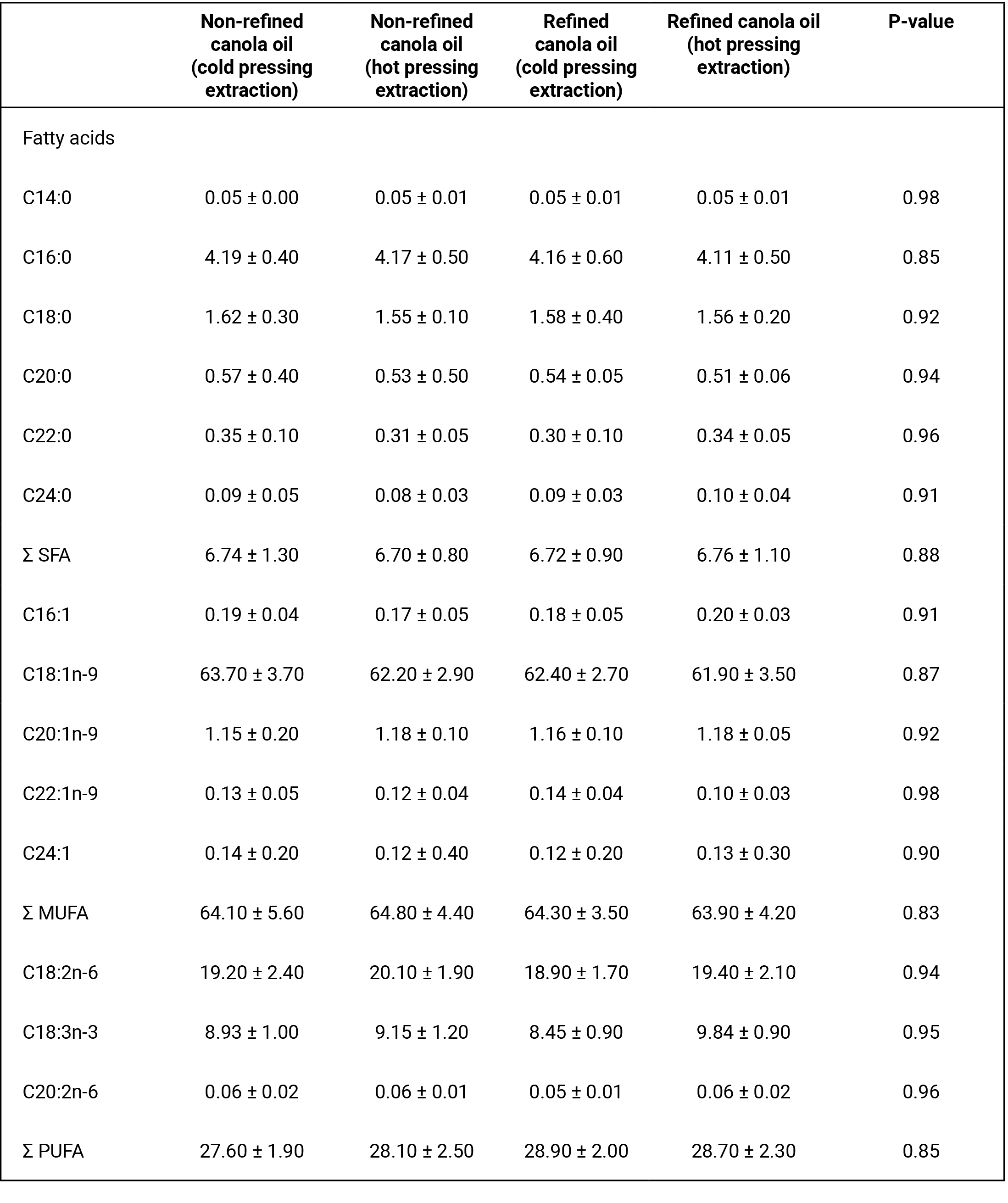
Fatty acid composition (g/100 g oil) of several canola oils. Results are reported as mean ± standard deviation (n=6). Values with different superscript letters within each row are significantly different (P<0.05).
3.2 Phytosterols content
Data regarding phytosterol content of canola oils analysed in this work are reported in Table 2. β-sitosterol was the main phytosterol found in canola oils followed by campesterol, whereas stigmasterol was found in much lower amounts. Although the amount of all phytosterols was slightly higher in the oils extracted at higher temperature in both refined and crude oils, these differences were not significant. However, as expected, the refining process drastically decreased the amount of phytosterols in the oils as these compounds are very sensitive to the aggressive operation conditions of refining. Phytosterol losses reached 96.94% in the cold-extracted canola oil after refining (from 382.70 to 11.7 mg/100 g oil) whereas hot-extracted canola oil lost 96.8% of its phytosterol content (from 388.5 to 12.44 mg/100 g oil).
Table 2. Phytosterols content in different canola oil.
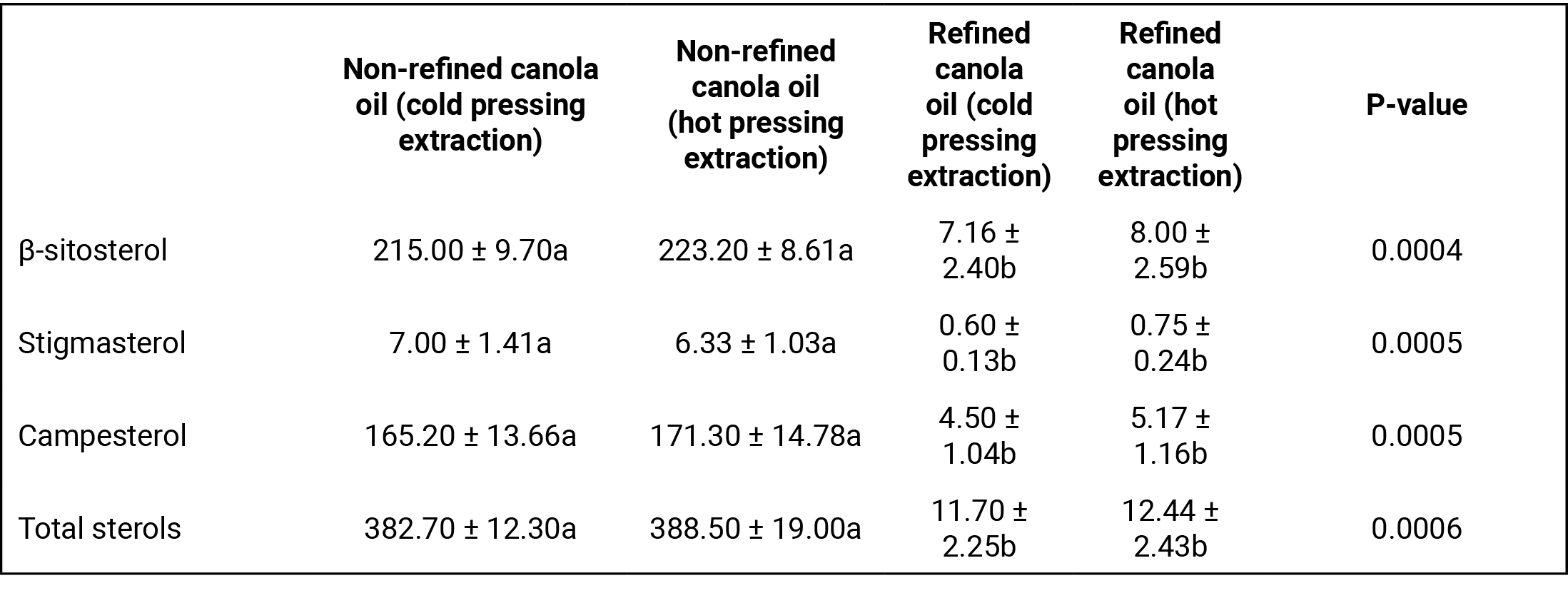
Amount of free phytosterols (mg/100 g oil) found in canola oil regarding extraction and refining processes. Results are reported as mean ± standard deviation (n=6). Values with different superscript letters within each row are significantly different (P<0.05).
3.3 Tocopherol and total phenol content, and antioxidant capacity.
Total tocopherol content (sum of α- and γ-tocopherol) was slightly but not significantly decreased by the effect of the extraction temperature in both crude and refined canola oils (Table 3), and γ-tocopherol was the most abundant in all cases. However, as in the case of phytosterols, refining sharply decreased the amount of tocopherols in canola oil: 85.8 and 88.0 % of tocopherols were removed from cold- and hot-extracted canola oil respectively after refining.
Regarding TPC, hot pressing significantly led to a large increase (3.1-fold) (104.5 µg GAE/g oil) in crude oil compared with the cold extraction (33.5 µg GAE/g oil) (Table 3). However, most phenols (95.4 and 98.2% for cold- and hot-extracted canola oils, respectively) were removed from oils after refining. The same trend observed for TPC was shown by the ORAC (oxygen radical absorbance capacity) values for crude oils: a 3.1-fold increase was noticed in the hot-extracted oil compared with the cold-extracted oil (Table 3), whereas refining deeply decreased ORAC values. In addition, the temperature extraction had a marked and significant effect on DPPH values found in crude canola oils, as hot-extracted oil showed 8.3-fold higher values (0.19 µmol Trolox equivalents/g oil) than cold-extracted oil (0.023 µmol Trolox equivalents/g oil). DPPH of refined oils (both cold- and hot-extracted) was significantly reduced compared with the hot-extracted crude oil but not with the cold-extracted crude oil (Table 3). In both methods (ORAC and DPPH) the antioxidant capacities were significantly higher when oils were extracted by hot pressing (Table 3).
Table 3. Tocopherol and total phenol content and antioxidant capacity in different canola oils.
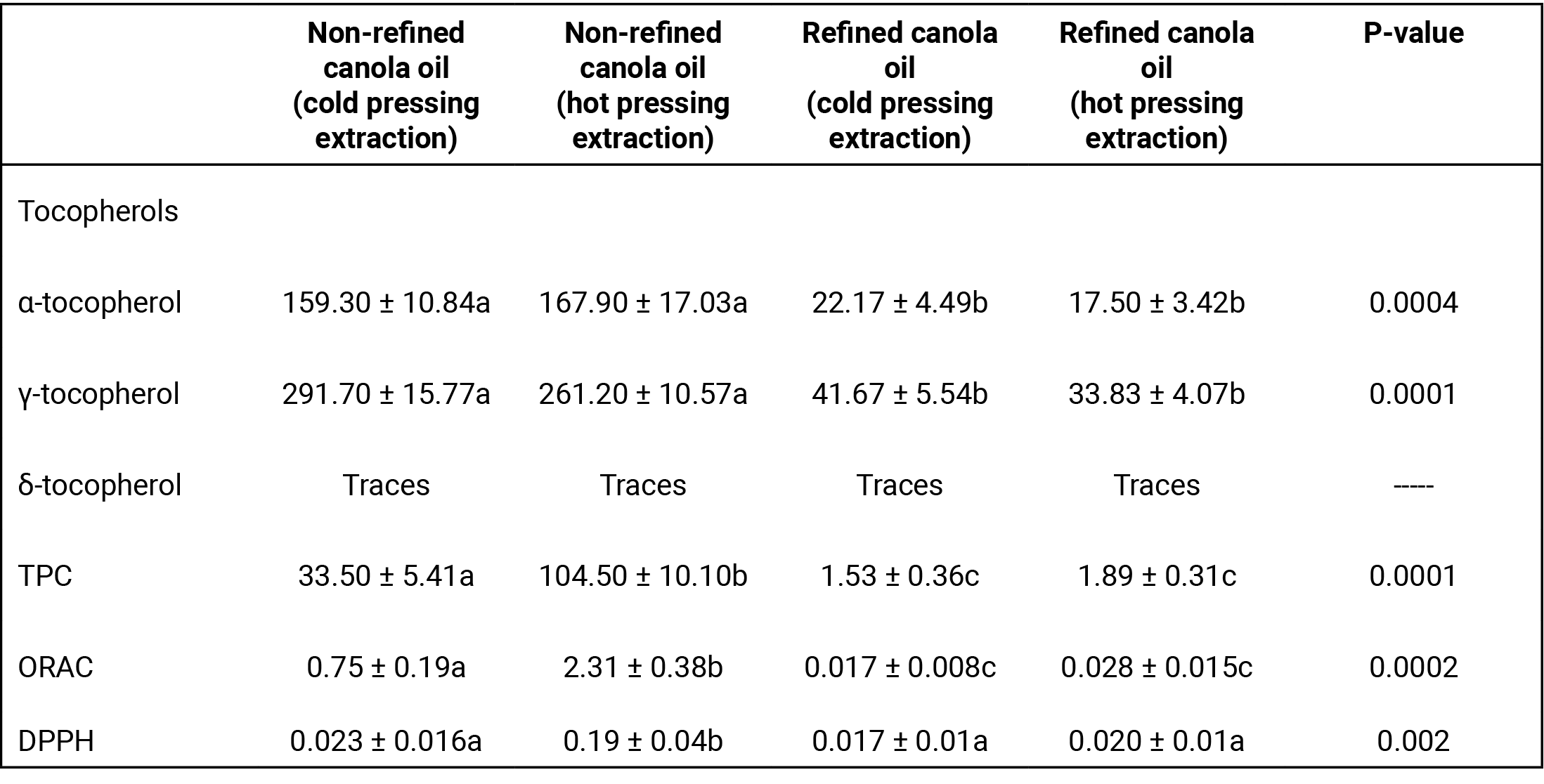
Amount of tocopherols (µg/g oil), total phenols (TPC) (µg GAE/g oil) and antioxidant capacity reported as ORAC (µmol Trolox equivalents/g oil) and DPPH (µmol Trolox equivalents/g oil) in canola oil regarding extraction and refining processes. Results are reported as mean ± standard deviation (n=6). Values with different superscript letters within each row are significantly different (P<0.05).
4. Discussion
4.1 Fatty acid profiles of canola oil regarding the extraction method and the refining process.
Canola oil has a particular FA composition, which is rich in MUFA (mainly OA, ≈ 64% of total fatty acids) and PUFA (mainly LA, ≈ 17% of total fatty acids) 20. A previous study reported oil extraction yields between 30.6 and 48.3% depending on the canola seed type, being oleic acid the most abundant FA (56.8-64.9%) followed by LA (17.1-20.9%)25. These data agree with results found in the current work, in which OA and LA were shown to be within the ranges 61.9-63.7% and 18.9-20.1% respectively.
Results from the current study found no significant differences in FA profiles of canola oils regardless temperature extraction or refining, although significantly different values were found for phytosterols and tocopherols among groups. These facts agree with previous research, showing no differences in FA composition regarding oil extraction procedure, whereas unrefined cold-pressed canola oil was rich in liposoluble vitamins, carotenes, and chlorophylls compared with a refined oil26,27.
4.2 Effect of pressing temperature on tocopherols, phytosterols, polyphenols, and antioxidant activity of canola oils.
Oxidation is one of the main reasons for the loss of quality of edible oils28. Those oils with a higher antioxidant capacity are more resistant to oxidation and therefore have a larger shelf life. The ORAC method has been used to quantify the antioxidant activity of oils by measuring the absorption of certain peroxides which induce oxidation in the presence of fluorescein29. The free radical assay (DPPH) is a widely used method to measure the capacity of different compounds to act as free radical scavengers or hydrogen donors, thus allowing the assessment of their antioxidant activity 19,30.
In the current study, the antioxidant capacity of unrefined oils extracted from seeds through cold or hot pressing was significantly different regarding both ORAC and DPPH methods. Phytosterols, tocopherols, and phenolic compounds are bioactive compounds with antioxidant properties which were found in both types of oil. However, despite no significant differences in phytosterol and tocopherol amounts were found in cold- or hot-pressed unrefined canola oils, the antioxidant capacity was significantly higher in the latter, measured by both ORAC and DPPH methods. It seems then that the antioxidant capacity of the analyzed canola oils is mainly explained by their content of phenolic compounds rather than to their phytosterols or tocopherols. In fact, TPC is 3.1-fold higher in oils produced by hot pressing, which is the same increase observed for the antioxidant capacity measured by ORAC. Our results agree with further evidence which pointed out that hot pressing increased the amount of phenolic compounds in rapeseed oil31.
A higher antioxidant activity in oils extracted by hot pressing was also found by other authors such as Siger et al., being the antioxidant activity gradually increased at a higher seed moisture and a seed roasting pre-treatment at 160 ºC for 5 min32. In this sense, other authors also reported an increased antioxidant activity of rapeseed oils after a seed roasting pre-treatment at 165 ºC which was proportional to the roasting time (0 to 100 min), with a significant correlation between antioxidant capacity and total phenolic content28. It has been reported that the capacity as free radical scavenger of polyphenols available in unrefined rapeseed oil was like that of butylated hydroxyanisole and ascorbic acid30.
It was shown that the ORAC methodology overestimated the antioxidant capacity of oils when compared with alternative assays such as DPPH, 2,2’-azinobis-(3-ethylbenzothiazoline-6-sulfonate) (ABTS), and ferric reducing antioxidant power (FRAP)33. Our results agree with this observation, as the antioxidant activity of unrefined canola oils measured by the ORAC method was higher than that obtained by the DPPH assay.
4.3 Effect of the refining process on the content- of tocopherols, phytosterols, polyphenols, and antioxidant activity in canola oils.
Oils are refined to remove undesired components such as free FA, phospholipids, gums, pigments, and trace metals. However, other molecules with biological interest are also lost during refining, as is the case of tocopherols and phenolic compounds34.
How physicochemical properties and oxidative stability of canola oil are affected by refining is not extensively reported in the literature yet. Total sterols (esterified and not esterified) account usually for up to 1.0% of total lipids in most refined vegetable oils35, which agrees with the amount of sterols found in the current study after refining. Regarding phytosterols, Tańska et al., reported higher values of campesterol and β-sitosterol in refined than in unrefined cold-pressed rapeseed oil11. Although these outcomes are not in agreement with the results obtained in the current study, they analyzed a commercially available refined rapeseed oil in which phytosterols could have been added after refining to increase the shelf life of the oil. Phytosterol losses are influenced by the refining conditions, and between 10 and 70% of phytosterols can be removed during refining.
In the current study, the losses of total tocopherols in the oil due to refining accounted for nearly 60% for cold-pressed oils and 50% for hot-pressed oils. Such differences could be due to differences in the deodorization time, or the bleaching clay used in each case. Kreps et al., checked the influence of physical refining of rapeseed oil at industrial scale on several chemical parameters, being physical deodorization, bleaching, and degumming the steps responsible for the highest losses of tocopherols compared with the unrefined oil (20.2-27.1%, 14.9-17.4%, and 6.6-8.4% loss, respectively)36.
The refining process sharply decreased the amount of total phenolic compounds and the antioxidant capacity for both hot- and cold-pressed oils, which is consistent with previous evidence, maybe due to the exposure of phenols to high temperatures11,37. Koski et al., also found that the aggressive conditions applied during oil refining led to a removal of hydrophilic phenols38. Phenolic compounds are widely distributed in crude seed oils extracted by pressing, but they are easily decomposed and polymerized during the refining process. This way, it is needed to develop strategies to minimize polyphenols losses in oils after refining39,19. Some interesting actions could be to carefully adjust physical refining and decreasing temperature and time during deodorization, as well as the selection of a more suitable bleaching material36.
Conclusion
Hot pressing according to a standard method in Chile increases bioactive compounds in crude canola oil, without altering the fatty acid composition. However, it is necessary to improve the refining parameters to avoid the loss of bioactive compounds (phytosterols, tocopherols, total phenols) and antioxidant capacity, being key points to optimize the temperature, deodorization time and bleaching earths. This study could be a basis for further studies on food and nutrition issues. In view of the fact that the effect of the refining process on micronutrients in canola oils is a topic widely analyzed in the literature, among the limitations of this study was the lack of measurement of β-carotene due to the fact that we do not yet have a standardized method.
Funding
This work was supported by Fondo Nacional de Desarrollo Científico y Tecnológico (National Fund for Scientific and Technological Research), FONDECYT Grant 1221098 (R.V).
Conflicts of interest
The authors declare no conflict of interest.
References
- Piazza GJ, Foglia TA. Rapeseed oil for oleochemical usage. Eur J Lipid Sci Technol. 2001; 103:450-4. https://doi.org/10.1002/1438-9312(200107)103:7<450::aid-ejlt450>3.0.co;2-d
- Lin, L., Allemekinders, H., Dansby, A., Campbell, L., Durance-Tod, S., Berger, A., Jones, P. J. Evidence of health benefits of canola oil. Nutrition Reviews. 2013; 71: 370-385. https://doi.org/10.1111/nure.12033
- Chain EP, Knutsen HK, Alexander J, Barregård L, Bignami M, Brüschweiler B, et al. Erucic acid in feed and food. EFSA Journal. 2016; 14: e04593. https://doi.org/10.2903/j.efsa.2016.4593
- Rzehak P, Koletzko S, Koletzko B, Sausenthaler S, Reinhardt D, Grübl A, et al. Growth of infants fed formula rich in canola oil (low erucic acid rapeseed oil). Clin Nutr. 2011; 30: 339-45. https://doi.org/10.1016/j.clnu.2010.11.002
- Canola Council of Canada. Canola 2021. Available from: https://www.canolacouncil.org/ [Accessed 6th May 2023].
- Zambiazi, R. C., Przybylski, R., Zambiazi, M. W., & Mendonça, C. B. Fatty acid composition of vegetable oils and fats. Boletim do Centro de Pesquisa de Processamento de Alimentos. 2007; 25: 111-120.
- Akyuz AP, M. Kerim, I. Karayucel, S. Dernekbasi, and S. Ustaoglu Tiril. Effects of Canola and Safflower Oil Supplementation in Diets, on Growth Performance and Fatty Acid Composition of Russian Sturgeon (Acipenser Gueldenstaedtii Brandt, 1833). Isr J Aquac. 2016; 68: 10. https://doi.org/10.46989/001c.20840
- Reyes P, Beatriz, Chamorro M, Rodrigo, Morales, Gladys, Hernández R, María Catalina, Farías C, Camila, & Valenzuela B, Rodrigo. Composición química y aplicaciones clínicas del aceite de oliva extra virgen. Rev Chil Nutr. 2023; 50; 320-331.
- Siger A, Gawrysiak-Witulska M, Bartkowiak-Broda I. Antioxidant (Tocopherol and Canolol) Content in Rapeseed Oil Obtained from Roasted, Yellow-Seeded Brassica napus. J Am Oil Chem Soc. 2017; 94:37-46. https://doi.org/10.1007/s11746-016-2921-7
- Flakelar CL, Prenzler PD, Luckett DJ, Howitt JA, Doran G. A rapid method for the simultaneous quantification of the major tocopherols, carotenoids, free and esterified sterols in canola (Brassica napus) oil using normal phase liquid chromatography. Food Chem. 2017; 214:147-55. https://doi.org/10.1016/j.foodchem.2016.07.059
- Tańska M, Mikołajczak N, Konopka I. Comparison of the effect of sinapic and ferulic acids derivatives (4-vinylsyringol vs. 4-vinylguaiacol) as antioxidants of rapeseed, flaxseed, and extra virgin olive oils. Food Chem. 2018; 240:679-85. https://doi.org/10.1016/j.foodchem.2017.08.007
- Rękas A, Siger A, Wroniak M, Ścibisz I, Derewiaka D, Anders A. Influence of de-hulled rapeseed roasting on the physicochemical composition and oxidative state of oil. Grasas y Aceites. 2017;68: e176. https://doi.org/10.3989/gya.0806162
- Shahidi F, de Camargo AC. Tocopherols and Tocotrienols in Common and Emerging Dietary Sources: Occurrence, Applications, and Health Benefits. Int J Mol Sci. 2016;17: 1745. https://doi.org/10.3390/ijms17101745
- Amiri M, Raeisi-Dehkordi H, Sarrafzadegan N, Forbes SC, Salehi-Abargouei A. The effects of Canola oil on cardiovascular risk factors: A systematic review and meta-analysis with dose-response analysis of controlled clinical trials. Nutr Metab Cardiovasc Dis. 2020; 30:2133-45. https://doi.org/10.1016/j.numecd.2020.06.007
- Chew SC, Ali MA. Recent advances in ultrasound technology applications of vegetable oil refining. Trends Food Sci Technol. 2021; 116:468-79. https://doi.org/10.1016/j.tifs.2021.08.001
- Verleyen T, Sosinska U, Ioannidou S, Verhe R, Dewettinck K, Huyghebaert A, et al. Influence of the vegetable oil refining process on free and esterified sterols. J Am Oil Chem Soc. 2002; 79:947-53. https://doi.org/10.1007/s11746-002-0585-4
- Bai G, Ma C, Chen X. Phytosterols in edible oil: Distribution, analysis, and variation during processing. GOST. 2021; 4:33-44. https://doi.org/10.1016/j.gaost.2020.12.003
- Wu Y, Zhou R, Wang Z, Wang B, Yang Y, Ju X, He R. The effect of refining process on the physicochemical properties and micronutrients of rapeseed oils. PLoS One. 2019 Mar 8;14: e0212879. https://doi.org/10.1371/journal.pone.0212879
- Xin L, Guo L, Edirs S, Zhang Z, Cai C, Yang Y, Lian Y, Yang H. An Efficient Deacidification Process for Safflower Seed Oil with High Nutritional Property through Optimized Ultrasonic-Assisted Technology. Molecules. 2022; 27: 2305. https://doi.org/10.3390/molecules27072305
- Chew SC. Cold-pressed rapeseed (Brassica napus) oil: Chemistry and functionality. Food Res Int. 2020; 131:108997. https://doi.org/10.1016/j.foodres.2020.108997
- Rincón-Cervera MÁ, Galleguillos-Fernández R, González-Barriga V, Valenzuela R, Speisky H, Fuentes J, et al. Fatty Acid Profile and Bioactive Compound Extraction in Purple Viper’s Bugloss Seed Oil Extracted with Green Solvents. J Am Oil Chem Soc. 2020; 97:319-27. https://doi.org/10.1002/aocs.12328
- AOCS PAOCsS. In Official Methods and Recommended Practices of the AOCS. AOCS Press. 1993; Champaign, IL, USA, 1993.
- Pino C, Sepúlveda B, Tapia F, Saavedra J, García-González DL, Romero N. The Impact of Mild Frost Occurring at Different Harvesting Times on the Volatile and Phenolic Composition of Virgin Olive Oil. Antioxidants. 2022; 11:852. https://doi.org/10.3390/antiox11050852
- Fuentes E, Paucar F, Tapia F, Ortiz J, Jimenez P,Romero N. Effect of the composition of extra virgin olive oils on the differentiation and antioxidant capacities of twelve monovarietals. Food Chem. 2018; 243:285–294. https://doi.org/10.1016/j.foodchem.2017.09.130
- Matthaus B, Özcan MM, Al Juhaimi F. Some rape/canola seed oils: fatty acid composition and tocopherols. Z Naturforsch C J Biosci. 2016; 71:73-7. https://doi.org/10.1515/znc-2016-0003
- Wroniak, M., Krygier, K., Kaczmarczyk, M. Comparison of the quality of cold pressed and virgin rape-seed oils with industrially obtained oils. Pol. J. Food Nutr. Sci. 2008; 58: 85–89.
- Saleem M, Ahmad N. Characterization of canola oil extracted by different methods using fluorescence spectroscopy. PLoS One. 2018; 13: e0208640. https://doi.org/10.1371/journal.pone.0208640
- Rękas A, Wroniak M. Oxidation kinetics of rapeseed oil pressed from microwave pre-treated seeds during long-term storage. J. Food Process. Preserv. 2018; 42: e13630. https://doi.org/10.1111/jfpp.13630
- Bermúdez-Oria A, Rodríguez-Juan E, Rodríguez-Gutiérrez G, Fernández-Prior Á, Fernández-Bolaños J. Effect of the Olive Oil Extraction Process on the Formation of Complex Pectin-Polyphenols and Their Antioxidant and Antiproliferative Activities. Antioxidants. 2021; 10: 1858. https://doi.org/10.3390/antiox10121858
- Koubaa M, Mhemdi H, Sanlaville Q, Vorobiev E. Recovery of Oil, Erucic Acid, and Phenolic Compounds from Rapeseed and Rocket Seeds. Chem Eng Technol. 2016; 39:1431-7. https://doi.org/10.1002/ceat.201500444
- He M, Nian B, Shi J, Sun X, Du R, Tan CP, Xu YJ, Liu Y. Influence of extraction technology on rapeseed oil functional quality: a study on rapeseed polyphenols. Food Funct. 2022 ; 13: 270-279. https://doi.org/10.1039/D1FO01507A
- Siger A, Józefiak M, Górnaś P. Cold-pressed and hot-pressed rapeseed oil: The effects of roasting and seed moisture on the antioxidant activity, canolol, and tocopherol level. Acta Sci Pol Technol Aliment. 2017; 16:69-81. https://doi.org/10.17306/J.AFS.2017.2017.0458
- Agregán R, Munekata PE, Domínguez R, Carballo J, Franco D, Lorenzo JM. Proximate composition, phenolic content, and in vitro antioxidant activity of aqueous extracts of the seaweeds Ascophyllum nodosum, Bifurcaria bifurcata and Fucus vesiculosus. Effect of addition of the extracts on the oxidative stability of canola oil under accelerated storage conditions. Food Res Int. 2017; 99:986-994. https://doi.org/10.1016/j.foodres.2016.11.009
- Lucci P, Bertoz V, Pacetti D, Moret S, Conte L. Effect of the Refining Process on Total Hydroxytyrosol, Tyrosol, and Tocopherol Contents of Olive Oil. Foods. 2020; 9: 292. https://doi.org/10.3390/foods9030292
- Tileuberdi N, Turgumbayeva A, Yeskaliyeva B, Sarsenova L, Issayeva R. Extraction, Isolation of Bioactive Compounds and Therapeutic Potential of Rapeseed (Brassica napus L.). Molecules. 2022; 27: 8824. https://doi.org/10.3390/molecules27248824
- Kreps F, Vrbiková L, Schmidt Š. Influence of industrial physical refining on tocopherol, chlorophyll and beta-carotene content in sunflower and rapeseed oil. Eur J Lipid Sci Technol. 2014; 116:1572-82. https://doi.org/10.1002/ejlt.201300460
- Chen Y, Thiyam-Hollander U, Barthet VJ, Aachary AA. Value-added potential of expeller-pressed canola oil refining: characterization of sinapic acid derivatives and tocopherols from byproducts. J Agric Food Chem. 2014; 62: 9800-7. https://doi.org/10.1021/jf502428z
- Koski A, Pekkarinen S, Hopia A, Wähälä K, Heinonen M. Processing of rapeseed oil: effects on sinapic acid derivative content and oxidative stability. Eur Food Res Technol. 2003; 217:110-4. https://doi.org/10.1007/s00217-003-0721-4
- Ye Z, Liu Y. Polyphenolic compounds from rapeseeds (Brassica napus L.): The major types, biofunctional roles, bioavailability, and the influences of rapeseed oil processing technologies on the content. Food Res. Int. 2023; 163: 112282. https://doi.org/10.1016/j.foodres.2022.112282
Explorar
Artículos
Volúmenes
Sobre la revista